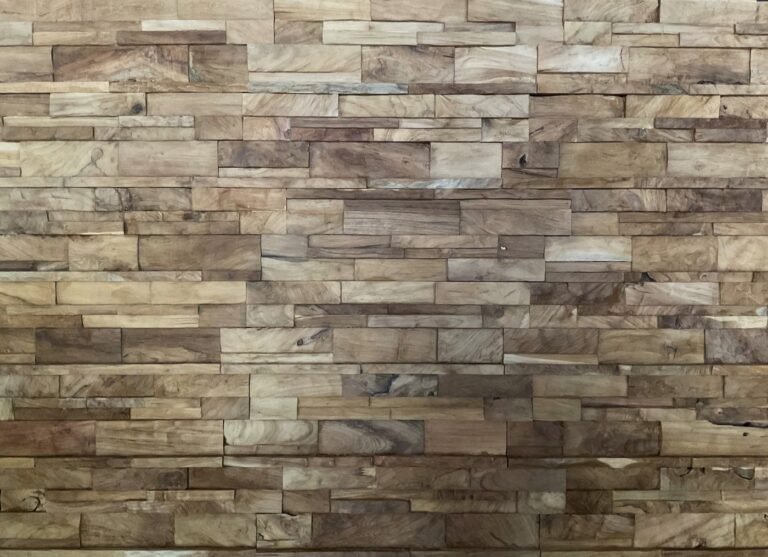
A teak beam from an old Javanese house has already had a long life: decades in the forest, then often further decades as a post, roof beam or wall board. When such houses are renovated or dismantled, the wood is far from finished. In our workshop in Jepara, Central Java, we turn it into wall panels, and not a single new tree has to be felled for it.
This article explains where reclaimed teak comes from, why a material that needs no new logging makes so much environmental sense, and what architects, interior designers and dealers should check when buying it.

Why wood without a new tree matters
Teak grows slowly. In Java, the state forestry company Perhutani manages its teak plantations on rotations of 40 to 80 years (FAO). A thick beam therefore represents generations of growth. Natural teak forests have also shrunk sharply: the IUCN Red List classifies Tectona grandis as Endangered.
Reusing existing teak pays off in three ways:
- No additional logging. Demand is met with wood that has already been harvested, not from a forest or plantation.
- Stored carbon stays stored. About half the dry mass of wood is carbon. Roughly speaking, a cubic metre of teak holds the equivalent of about one tonne of CO₂. As a wall panel, that carbon stays locked up for further decades instead of being released through burning or decay.
- Far less energy in production. A US Forest Service study (Bergman et al., 2010) found that new wood flooring takes about 13 times as much energy to produce as reclaimed flooring. Its global warming potential was about 5 times higher (source).
This also fits the logic of the EU Waste Framework Directive (2008/98/EC). Its waste hierarchy puts prevention and reuse ahead of recycling and energy recovery. A teak beam that lives on as wall cladding sits near the top of that hierarchy.
Where our reclaimed wood comes from: old houses in Central and East Java
For generations, traditional homes in Java were built from teak: load-bearing posts, roof beams, wall boards, doors and carved partitions. Teak was available locally, and its natural oils made it resistant to moisture and insects. Many of these houses have stood for more than 50 years.


When these houses are renovated or dismantled, we buy the wood in Central and East Java. The marks of time remain visible: nail holes, mortise-and-tenon joints, traces of blue, green or reddish-brown paint. That is exactly what gives the material its character.

Our position: a house that can be preserved should stay standing. Preservation is always the best solution. Reusing the wood comes second, and it is far better than using new timber.
From beam to wall panel: how we process reclaimed teak
- Sorting: we select only sound beams and planks. Rotten or heavily damaged pieces are rejected.
- Cleaning: nails, fittings and loose paint are removed. The patina stays where it is part of the design.
- Protection: the wood is pressure-impregnated against insects and termites.
- Drying: to a moisture content of 10% ± 2%, suitable for heated interiors in Europe.
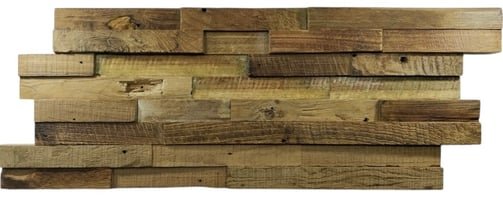
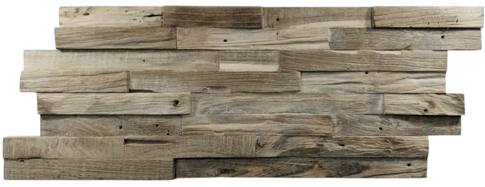
- Manufacturing: cut into lamellas and bonded with B4/D4 glue into panels of 500 × 200 mm and 8–20 mm thick, 10 pieces (1 m²) per box.
- Finish: Nature, Weathered Grey or Rustic Old. The three tones can be combined on one wall.

What makes reclaimed teak special in an interior
- A patina you cannot fake: decades of sun, rain and use create a depth of colour and grain that new wood does not have.
- Calm, stable wood: old teak has had a long time to dry and settle. Together with its natural oil content, that means little movement indoors.
- Every panel is unique: ideal for feature walls in hotels, restaurants, offices, shops and homes.
- A story worth telling: for brands with sustainability goals, an origin in old Javanese houses is a genuine argument.
To be honest: reclaimed teak is a rustic grade. Knots, fine cracks, nail holes and colour differences are part of it. If you want a perfectly even surface, new knot-free timber will suit you better.
Proof: FSC Recycled, SVLK and EUDR
With reclaimed wood, buyers are right to ask whether the origin can be proven. Our answer:
| Evidence | What it means |
|---|---|
| FSC 100% Recycled | We hold FSC Chain of Custody certification (FSC-C141539). Eligible lots are sold with the claim “FSC 100% Recycled” on the invoice. |
| SVLK / V-Legal | Indonesia’s national timber legality system. Every export shipment receives a V-Legal document (more about SVLK). |
| EUDR | The EU Deforestation Regulation applies from 30 December 2026 to large and medium companies, and from 30 June 2027 to micro and small companies. Under Annex I, products made entirely from material that has completed its lifecycle and would otherwise be discarded as waste are in principle excluded. Delegated Regulation (EU) 2026/2102 clarified the rules on waste and used goods. Please check the current text to see whether your shipment qualifies. We supply the origin documents in every case. |
Read more: EUDR for wood wall panels: what EU importers need from suppliers. This section is general information, not legal advice.
Checklist for specifiers and dealers
- Ask for proof of origin: photos and documents for the reclaimed lot, not just a “reclaimed” label.
- Check the FSC claim on the invoice: only then can you pass the Recycled claim on to your customers.
- Ask for the moisture content: for Europe, 10% ± 2% is a good guide value.
- Order samples: with reclaimed wood, only the real piece shows colour, texture and variation.
- Allow for cutting waste: a reserve of about 10% is usual for cuts around corners, windows and sockets.
Frequently asked questions
Is reclaimed teak as durable as new teak?
Yes, provided it is carefully sorted. Old teak from house structures generally comes from older trees and is rich in oil. We use only sound wood, treat it against insects and dry it to 10% ± 2%.
Does the wood contain chemicals?
Traces of old paint are part of the look, and we remove visible loose paint. If your project requires a specific treatment or test certificate, please contact us before ordering.
Where can the panels be used?
Indoors: living rooms, bedrooms, hotel lobbies, restaurants, offices and retail fit-outs. They are not intended for exterior façades or wet areas.
Do you also supply reclaimed beams and planks?
Yes. Besides wall panels, we make furniture from reclaimed teak and sell beams as raw material. Sizes vary by lot, and we can send a stock list on request.
Conclusion
Reclaimed teak combines what building owners look for today: real solid wood with character, a provable origin and a material for which no tree had to be felled. Every square metre made from an old Javanese house is a square metre of teak that can stay standing in the forest.
Interested? See the Teak FSC Reclaimed panel and all our teak wall cladding, or request samples and a quote.
CV. Sony Sentral Industri, Jepara, Indonesia. Manufacturer of teak wall panels since 2011, FSC-C141539, SVLK certified.